
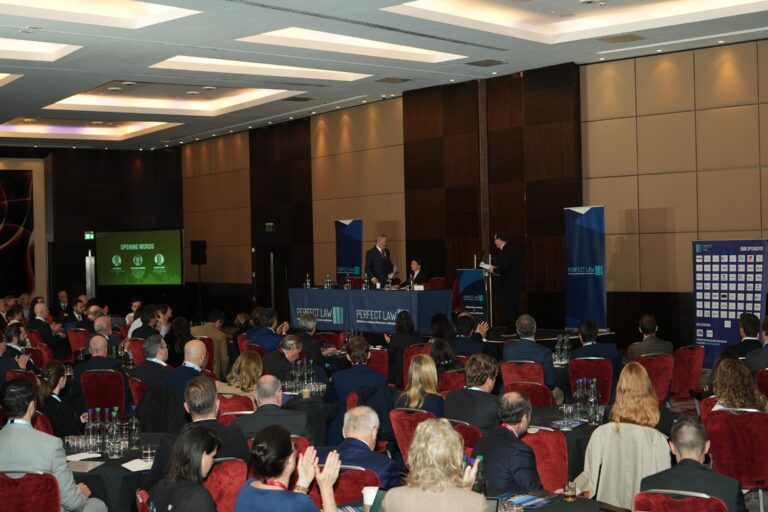
The Global Class Actions & Mass Torts Conference by Perfect Law LTD took place on 24-25 April 2025 at the Park Plaza London Westminster Bridge. The event brought together over 200 eminent practitioners, academics, funders, experts, and service providers in the field of class actions and mass torts from the US, Canada, the UK, Australia, and across Europe.
The conference was kicked off with welcoming words by Eric Cramer, Chairman of Burger Montague PC (US), Dr. Ariel Flavian, Partner at Herzog Law and Visiting Lecturer at Haifa University (Israel), and Prof. Ianika Tzankova, Co-founder of Rubicon Law Office and Professor at Tilburg University (Netherlands). The Perfect Law conference aims to advance and facilitate the collective redress regimes all over the globe, while fostering insightful discussions on developments, trends, and takeaways in the field of class actions.
The first panel about global trends in Class Action Litigation was chaired by Prof. Ianika Tzankova (The Netherlands), who highlighted that mass claims are not only a trend but rather an established feature of developed societies. Prof. Stefaan Voet, Professor at the University of Leuven (Belgium), outlined how the 2020 EU Representative Actions Directive has been implemented differently across Europe, resulting in having no single model for collective redress in Europe. While countries like the Netherlands and Belgium have expanded their existing systems, other countries, especially in Eastern Europe, have simply copied the Directive with limited practical effect. He stressed that the Directive’s impact remains modest because many jurisdictions lack procedural flexibility, judicial support, and viable funding structures. He concluded that without better case management and sustainable funding, collective actions in Europe will continue to face significant obstacles. Turning to Italy, Justice Remo Caponi, Italian Supreme Court Judge, described how Italy has implemented the Directive and developed a dual-track system that allows collective actions to extend beyond consumer protection into fields like labour, competition, and data privacy. Caponi emphasized the symbolic importance of moving collective actions from the Consumer Code to the Civil Procedure Code. He noted that the class actions are gaining momentum in Italy as over 80 actions have been filed since the reform, with more than 50 in the last three years. However, he warned that judicial delays, the need for better funding and more strategic case management remain crucial challenges if the system is to reach its full potential. Dr. Peter Cashman, Adjunct Professor of Law at the University of New South Wales (Australia), shared insights from over three decades of Australian class action experience. He described how the system operates with minimal thresholds and no formal certification stage, resulting in steady growth and widespread use of commercial litigation funding. Cashman explained how Australian courts scrutinize funder fees through contradictors and independent cost assessors, while trends such as portfolio funding and carriage motions have added new dynamics to the practice. He noted that while the system remains efficient compared to other jurisdictions, the high transaction costs—up to 50% of recoveries—should be addressed to ensure class actions remain accessible and fair. Prof. Brian Fitzpatrick, Milton R. Underwood Chair in Free Enterprise and Professor of Law at the Vanderbilt University School of Law (US), provided an empirical perspective on the US system, which allows class actions for any type of claim under its opt-out model. He discussed three trends: first, that arbitration agreements have not destroyed class actions as feared, remaining filing rates and settlements remaining; second, that cases often settle quickly—regularly before a motion to dismiss or class certification is decided—which offers quick access to justice but may reduce proper testing of claims; and third, that the current political climate could ironically benefit class actions, as conservative judges and a weaker federal enforcement role may lead to greater reliance on private enforcement through class actions.
Eric Cramer, Chairman of Berger Montague PC (US), introduced the second panel on Class Action Case Management by outlining its goal to compare how different jurisdictions manage large and complex class action cases. Hon. Amy St. Eve, Judge at the United States Court of Appeals for the Seventh Circuit (US), described the two main ways mass claims are handled in US federal courts: traditional class actions under Rule 23 and multi-district litigation (MDL). She explained that Rule 23 allows a single representative to bring claims on behalf of a larger group, but for damages cases, the rule requires that common issues must predominate over individual ones — a test that is hard to meet for mass tort claims. As a result, large mass torts instead regularly use the MDL process, where similar cases from across the country are transferred to one judge for coordinated pre-trial proceedings. She noted that MDLs, governed by a special panel of seven judges, now make up over half of the federal civil docket. A high-profile example was the 3M combat earplugs case with over 300,000 individual cases were consolidated, resulting in a $6 billion settlement. She also highlighted a new Rule 16.1, which is expected to be implemented in December 2025 and aims to encourage more active judicial management. Mr. Justice Constable, Judge of the High Court of England and Wales, King’s Bench Division (UK), outlined the UK’s opt-in group litigation model, with limited opt-out actions available only in the Competition Appeal Tribunal (CAT). He described how the group litigation order (GLO) procedure works for large cases like the ongoing diesel emissions litigation. He emphasized the importance of “set piece” case management hearings to agree on core issues, evidence timetables, and trial structure. Between these, regular informal online meetings help identify emerging problems early. Justice Constable also discussed the UK’s costs management framework, where courts set reasonable budgets in advance to help manage expectations and encourage settlement. He noted how proactive management and cooperation among parties can streamline huge cases with many claimants and defendants. Judge María Arantzazu Ortiz González, Appellate Judge at the Provincial Court of the Balearic Islands (Spain), provided an overview of the Spanish approach, where sector-specific laws allow consumer associations to bring collective actions. She noted that Spain does not yet have a unified opt-in or opt-out system but is expecting to adopt the EU Representative Actions Directive soon. She described how large numbers of individual claims have functioned in practice like mass actions, as coordination among courts and standardized hearings ensured to have similar cases combined, enabling consistent rulings and having resolved thousands of claims efficiently. Judge Larisa Alwin, Appellate Judge at the Amsterdam Court of Appeal (The Netherlands), explained the Dutch Act on redress of mass damages in collective action (WAMCA), which allows foundations or associations to bring collective claims on behalf of affected individuals. She described how the court defines the affected group, sets out admissibility in a first procedural phase, and then proceeds to the merits. Recent changes have introduced more extensive disclosure tools to simplify access to evidence. For case management, she emphasized the importance of maintaining a “bird’s eye view” of the entire proceeding, thinking in scenarios, and encouraging parties to cooperate early. She highlighted the value of preparatory meetings and interim hearings to resolve disputes, adjust timetables, and keep complex cases moving forward without unnecessary delay.
The third panel, addressing the negotiation and monitoring of settlements, brought together prominent legal experts. Jeremy A. Lieberman, Managing Partner of Pomerantz LLP (US), chaired the discussion, emphasizing the challenges inherent in securing settlement approvals. Marco Pierani, Public Affairs and Media Relations Director at Euroconsumers (Italy), initiated the debate by drawing on his experience with the Dieselgate scandal, which exposed inefficiencies in Europe’s settlement mechanisms. While the U.S. achieved an early resolution, Italy and Belgium finalized settlements only after nine and ten years of litigation, respectively, while Spain and Portugal remain pending. Pierani stressed the importance of expedited settlements—whether judicial or extrajudicial—to ensure efficiency for class members, claimants and defendants. Delays, he noted, may harm defendants’ reputations despite their tactical preference for prolonging proceedings. He further underscored that plaintiffs have to be aware of the huge responsibility in negotiations they have and advocated for global settlements encompassing all affected consumers. Charlotte Spiering, Counsel at Clifford Chance LLP (the Netherlands), examined the Dutch legislative framework, noting its intent to facilitate settlements. Prior to the WAMCA’s enactment, a voluntary out-of-court settlement mechanism existed—and remains in force—though no approval requests have been submitted under this regime since the WAMCA’s implementation. The current legislation seeks to promote settlements by mandating a settlement attempt immediately following the admissibility phase. Nevertheless, Spiering critiqued the timing of this requirement, as defendants often resist negotiations in the absence of a liability ruling. The uncertainty of the new system, she argued, also disincentivizes plaintiffs from engaging in early settlement discussions. Nicholas Gibson KC, Barrister at Matrix Chambers (UK), highlighted that settlements typically occur post-certification, as proximity to trial increases the certainty of how to show that the settlement is just and reasonable. Nonetheless, he urged claimants to advance cases efficiently, as defendants often exploit delays to undermine financial viability. Progression toward trial, he argued, heightens reputational risks for defendants. Effective settlements, he concluded, must balance the interests of class members, funders, and defendants. Hodge Malek KC, Deputy High Court Judge and Chairman of the UK Competition Appeal Tribunal (UK), expressed strong support for settlements while acknowledging parties’ strategic incentives to await certification. He clarified that judicial approval should not replicate a full trial or be a “mini-trial” but rather assess whether settlements are just and reasonable, considering potential conflicts of interest and broader systemic implications. The court has to protect the class members but also ensure that the system continues working. Although objectors may emerge, he noted, class members rarely participate directly in proceedings.
Tom Moore, UK Managing Director at Angeion Group (UK), chaired the fourth panel, which addressed actual recovery and cy-près distribution. He introduced the discussion by emphasizing that low take-up rates render the issue of residual funds particularly significant. Professor Suzanne Chiodo, Assistant Professor at the York University (Canada), opened the panel by arguing that even though class actions aim to modify behaviour, the primary focus should remain on compensating class members. She characterized U.S. take-up rate data as remarkably low, underscoring the need for measures to improve these rates and ensure direct compensation. In the UK, she noted, residual funds are fixed upon judgment but treated more flexibly in settlements. Comparative research reveals that many settlements incorporate cy-près solutions, though recent trends in Ontario restrict such distributions to residual amounts—rather than the entire award—to prioritize direct compensation. Mr. Justice Smith, Judge of the High Court of England & Wales (UK), identified a fundamental tension in the UK’s regulatory framework for residual funds, which serve dual purposes: compensating class members and discharging the obligations to funders and lawyers. He warned that failing to adequately compensate victims risks undermining the regime’s credibility, reducing litigation to a mere mechanism for servicing financial intermediaries. Conversely, he cautioned that an efficient cy-près distribution could destabilize the system unless funders and lawyers are assured remuneration for their risks. Thus, he concluded, funding mechanisms and cy-près distributions are inextricably linked to the regime’s viability. Hon. Robert Dow, United States District Court Judge and Counselor to Chief Justice John Roberts of the U.S. Supreme Court (US), echoed Justice Smith’s call for judicial vigilance in settlement assessments. While acknowledging the courts’ authority to reject settlements, he noted the inherent difficulty in determining what constitutes a “just and reasonable” settlement. Judge Dow affirmed the consensus that victim redress remains the paramount goal of class actions, though he recognized competing interests, such as attorneys’ fees and defendants’ desire for global peace. In the US, he explained, cy-près distributions are contentious and typically approved only as a last resort—preference is given to secondary distributions to class members unless administrative costs outweigh residual amounts. He further highlighted that reversionary clauses may raise concerns, as they risk diluting the robustness of notice efforts. Deborah Greenspan, Partner at Blank Rome LLP (US), illustrated these challenges with her own experience, detailing a year-long judicial effort to allocate undistributable residuals efficiently. She cited two additional cases where cy-près distributions were approved, demonstrating that the nature of the settlement and type of damages influence permissible solutions. Greenspan stressed that take-up rates hinge on factors like communication strategies, necessitating precise identification of class members to tailor outreach and damage assessments effectively.
The fifth panel was chaired by Louise Trayhurn, Executive Director at Legis Finance (UK), who opened the session by introducing the panellists and noting the continued importance of litigation funding throughout the conference. She framed the discussion as an opportunity to explore unresolved questions in funding, including the impact of recent UK and international developments. Justice Foxton, High Court (UK), reflected on the growing prominence of litigation funders in disputes, noting that funders increasingly appear as central actors rather than background financiers. He focused on the implications of the PACCAR decision, which disrupted settled assumptions around funding agreements, and highlighted the ongoing uncertainty pending further clarification. Drawing on recent cases, he examined disputes settlement structures and funder entitlements, raising concerns about non-monetary settlements in environmental and family law contexts. He also noted a shift towards arbitration in funding disputes, potentially driven by confidentiality and stronger contractual enforcement. Travis Lenkner, Chief Development Officer at Burford (US), addressed the evolving role of litigation funding in collective actions, using the Cisco case to clarify misconceptions. He explained that Burford’s $140 million investment was a corporate monetization, not litigation funding, and initially involved no control or settlement rights. However, when Cisco breached the contract by transferring claims, Burford gained limited consent rights under a restructured agreement. More broadly, Lenkner emphasized that capital is essential to the viability of mass claims regimes, especially outside the US. He warned that if legal systems rely on funding but remain hostile or unpredictable toward capital, they risk undermining access to justice entirely. Dai Wai Chin Feman, Managing Director at Parabellum Capital (US), explored the critical legal and policy dynamics surrounding litigation funding, particularly in the US context. He emphasized that funding agreements rest on a duty to litigate in good faith and maximize claim value—responsibilities that justify certain limited funder protections, like consent rights. Turning to regulation, he outlined growing pressure from defendants and the US Chamber of Commerce for disclosure, often as a tactical weapon rather than a call for transparency. He described a landmark compromise in Kansas—disclosure to courts in camera only—now seen as a model for other states. Feman concluded with a warning about the real harms of public disclosure, including interference and pressure campaigns by defendants, underlining that funders “have nothing to hide—but something to protect”. Prof. Susanne Augenhofer, Professor of Law at the University of Innsbruck (Austria), examined the evolving regulatory landscape for third-party litigation funding (TPLF) across the EU, emphasizing the lack of harmonization and persistent national divergence. She highlighted that the Representative Actions Directive—the EU’s only legislative instrument touching on TPLF—remains vague and limited to consumer claims, leaving business-to-business (B2B) litigation largely unregulated. She discussed the March 2024 EU “mapping study”, a comprehensive 706-page analysis of national regimes, noting it contained few surprises but may influence future reform. Augenhofer contrasted Member States’ varied approaches—from Greece’s ban to Germany’s restrictive 10% funding cap—and outlined three possible EU paths forward: no action, light-touch regulation (her preferred model), or strict oversight. She concluded that continued hostility in parts of Europe may chill funding, despite its growing relevance in areas like antitrust and digital markets. John Walker, Chairman of the Association of Litigation Funders of Australia (Australia), reflected on over 30 years of experience in the Australian market, where opt-out class actions, cost-shifting rules, and limited contingency fees have made third-party funding essential. He described the regulatory pendulum: from court acceptance in 2007 to the 2020 designation of funded claims as managed investment schemes (requiring burdensome compliance), then full deregulation in 2022. Courts remain the key supervisory force. He outlined pending High Court decisions that may reshape common fund orders and whether funder fees can be recovered directly from defendants.
The sixth panel was chaired by Prof. Miguel Sousa Ferro, Professor at the University of Lisbon and Managing Partner at Sousa Ferro & Associados (Portugal), who introduced the topic of forum shopping in cross-border collective redress. Prof. Sousa Ferro opened the session by asking whether global legal solutions have emerged to address cross-border infringements, noting the challenge of achieving binding outcomes across jurisdictions. Sylvie Rodrigue, Managing Partner at Torys LLP (Canada), presented the Canadian experience, where all provinces and the federal court have opt-out class action regimes. She explained that in the absence of formal consolidation rules, Canada developed judicial protocols enabling coordination across provinces through joint case management and unified notices. The leading 2017 Airia Brands decision established a three-part test for including foreign class members: real and substantial connection, common issues, and procedural safeguards such as adequate notice and opt-out rights. Global classes have been certified in antitrust and securities cases but not in consumer cases due to legal divergence. Rodrigue emphasized that even when certification is granted, enforceability abroad remains uncertain unless mirrored by foreign proceedings or protocols. Jeremy Sher, Co-Head of the Global Class Actions Group at DLA Piper (UK), spoke from the defence perspective, emphasizing that global class actions pose operational and economic challenges for clients. While recognising local legal differences, he noted that defence strategies focus on managing global risk rather than jurisdiction alone. England remains a key jurisdiction, handling 48% of European mass claims. Sher highlighted the English courts’ growing willingness to accept jurisdiction, especially in parent company liability cases. He also discussed how defendants may pre-empt class actions through contractual settlements or voluntary remediation, and by leveraging different legal systems to manage exposure strategically. Caroline Taylor, Founding Partner of Ignitis (US), reframed forum shopping as a strategic and necessary element of effective legal practice, rather than a negative tactic. Drawing on her experience as a litigator and now funder, she emphasized the importance of consciously selecting jurisdictions to maximize pressure on defendants. Taylor discussed past efforts to file data protection claims in the US on behalf of UK claimants and how even unsuccessful actions can yield jurisdictional advantages. She advocated for creative coordination across jurisdictions and stressed that meaningful threats often come from cases in pure opt-out systems. Taylor also cautioned against overly ambitious EU-wide mechanisms, urging incremental national developments as a more practical path forward. Giorgio Afferni, Managing Partner at Delex Law Firm (Italy), outlined the Italian framework for collective redress, which includes the EU Representative Action, a national class action mechanism, and the assignment of claims model. All available procedures in Italy are opt-in, with no current opt-out system. He described recent cross-border activity, such as a Milan-based class action against Philips following a US settlement, and actions against Italian parent companies for foreign harms, including human rights violations in Nigeria. Afferni noted enforcement challenges for foreign opt-out judgments in Italy, highlighting the need for facilitated opt-ins. He also discussed consolidation rules that require similar actions in Italy to be merged, potentially enabling broader settlements in low-value cases. Robert van Hattum, Senior Associate at De Brauw Blackstone Westbroek (Netherlands), examined the Dutch collective redress landscape, which uniquely offers two opt-out mechanisms: the WAMCA for damages and the WCAM for settlements. While WAMCA has enabled over 100 filings in five years, it remains largely domestic in scope due to strict admissibility criteria—such as requiring that most class members reside in the Netherlands, or that the harm occurred there. Opt-out is standard for Dutch residents, but foreign claimants must opt in unless individually known. Given these constraints and WAMCA’s legal uncertainties, many claimants still prefer the assignment model. Van Hattum also discussed WCAM’s broader international utility: it allows jointly petitioned settlements with opt-out applicability to foreign class members and has been accepted by Dutch courts in landmark global settlements like Shell and Converium. These decisions creatively addressed jurisdictional gaps in Brussels I by treating class members as defendants, though Van Hattum cautioned this approach may not extend to consumer claims due to EU-specific protections. He concluded that WCAM remains a promising route for global resolution, especially in securities and competition cases, offering finality through opt-out settlements.
Eduardo Silva de Freitas[1]
Leire Gutiérrez Molina[2]
Linus Bättig[3]
[1] Board Member of Ius Omnibus
[2] PhD candidate, University of the Basque Country, Spain
[3] Junior Associate at Niederer Kraft Frey Ltd., Switzerland.

Copyright © 2026. Perfect Law Ltd. All Rights Reserved.