
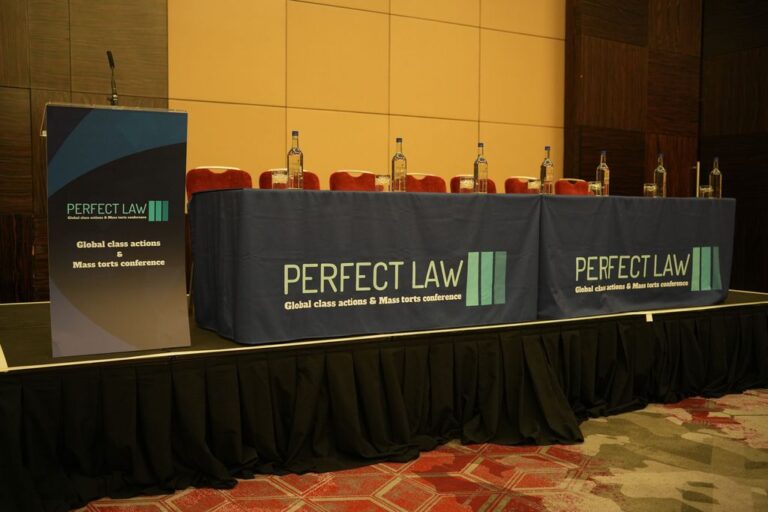
The session in room 2 was opened with welcoming words from Clare Ducksbury, CEO & Founder of Case Pilots (UK), who highlighted, both, some takeaways of day 1 and the topics that would be covered throughout the day, pointing out that some of them are hot topics, such as data privacy actions.
The first panel on data privacy actions was moderated by Paul Karlsgodt, Partner at Baker Hostetler LLP (US), who initiated the discussion by presenting a case study on a data privacy mass claim. This example served as a foundation for addressing various aspects of class actions in privacy litigation. Throughout his interventions, Karlsgodt emphasized the striking observation that, in some cases, notice to class members is provided by the very company or tool against which the claim is being pursued. Glenn Danas, Partner at Clarkson Law Firm (US), commenced the panel by offering a comprehensive overview of the legal framework for privacy enforcement in the United States, with particular emphasis on California’s regulatory regime, where he primarily practices. Danas noted that California’s legal landscape in this domain is notably dynamic. He also reminded attendees that, under US law, notice of an action or settlement does not require individual delivery, allowing for innovative notification methods. John A. Yanchunis, Class Action Department of Morgan & Morgan (US), underscored the critical role of consent in data processing and highlighted the growing consumer awareness regarding data protection in the United States. Yanchunis observed that, outside California, quantifying damages in privacy violation cases remains challenging. He outlined two predominant approaches to monetizing damages in such cases: (1) calculating the compensation paid by the data-processing company to its users (e.g., Google’s monthly payment to users) or (2) assessing the defendant’s profits derived from the infringement (e.g., revenue generated from unauthorized web browsing). Additionally, Yanchunis pointed out the inefficiencies in negotiating notification procedures with defendants, which often delay the process and create challenges for claims administrators in reaching class members. Ursula Pachl, Head of Collective Redress and Senior Advisor at noyb (Austria), provided an analysis of the current legal framework for collective redress in the European Union (EU), noting that the region is still in the early stages of developing collective action mechanisms, particularly concerning redress for privacy violations. Pachl emphasized the significance of the General Data Protection Regulation (GDPR), which explicitly recognizes the right to seek both material and non-material damages, though she acknowledged the evidentiary burdens associated with such claims. Among the key challenges she identified were the need for judicial familiarity with GDPR provisions, the absence of harmonized rules on jurisdiction and applicable law for cross-border data and privacy disputes, the lack of a unified European model for collective actions, and the necessity for disclosure mechanisms. Pachl also contrasted the EU’s approach to class member notification with that of the US, stressing that noyb adheres strictly to consent-based notifications and rejects targeted notification strategies commonly employed in American litigation. Kristen Stallings, Senior Vice President of business development with Rust Consulting (US), focused on the practical aspects of settlements in US privacy class actions. She explained that plaintiffs are required to develop a structured plan for notifying class members and distributing settlement funds. Stallings highlighted the difficulties in identifying and reaching affected individuals, noting that email remains the most efficient and widely used notification method. When email addresses are unavailable, alternative methods are employed to locate them. Additionally, she emphasized the obligation to disseminate notices through social media platforms to ensure broader accessibility.
John Yanchuni from the Class Action Department of Morgan & Morgan (US), chaired the second panel on class action litigation in the digital era, emphasizing that today’s largest corporations—such as Google, Meta, and Amazon—routinely collect and monetize user data. Marco Scialdoni, Head of Litigation & Academic Outreach at Euroconsumers (Italy), began his remarks by highlighting the significance of the Digital Markets Act (DMA) and the Digital Services Act (DSA) in the EU. He clarified that while the DMA does not seek to regulate all facets of digital markets, it does facilitate collective redress mechanisms. Scialdone argued that the EU requires a harmonized class action system, preferably based on an opt-out model, given that many claims involve small individual damages. He further stressed that private enforcement should complement—rather than replace—public regulatory efforts. Julie Liddell, founder of EdTech Law Center (US), focused her intervention on children’s privacy, particularly in the context of marketing practices within educational institutions. She observed that while no legal provision explicitly strips children of their privacy rights in schools, such violations frequently occur in practice. Liddell also underscored broader concerns regarding data opacity —namely, the lack of transparency surrounding data ownership, acquisition methods, and usage. Thomas Loeser, Partner at Cotchett Pitre & McCarthy, LLP (US), expanded on Liddell’s arguments by critiquing the prevailing business models of tech companies, which he characterized as exploiting future generations. He noted that while digital services are often presented as “free”, the true cost is users’ personal data. Loeser also contrasted the absence of robust public enforcement in the US with private litigation efforts, citing examples such as class actions against companies that sell mobile phone users’ driving behaviour to insurers. Margriet De Boer, Partner and Co-founder of dispute resolution boutique Ysquare (the Netherlands), discussed developments in the Dutch legal landscape following the implementation of the WAMCA. She noted that Dutch courts have seen a surge in collective privacy actions. In fact, by the time, she highlighted that there were 12 pending cases against major platforms such as TikTok, Apple, Meta, X, Google, Amazon, Adobe, and Tinder, seeking both injunctive relief and monetary compensation. De Boer advocated for a balanced approach, arguing that private enforcement should supplement—not supplant—public oversight. She also called for a unified European class action mechanism to eliminate fragmentation, stressing the need for clear criteria on claim’s similarity and some other aspects to enable collective settlements and foster a litigation funding market. Mariana Tavares, Counsel at Antas da Cunha ECIJA (Portugal) concluded an enriching panel by acknowledging the benefits of private enforcement, while cautioning that litigation may deter corporate cooperation with regulatory authorities due to fears of follow-on claims. She argued that stand-alone private enforcement should be strengthened, particularly to facilitate early dispute resolution.
The third panel, chaired by Matthew Hughes, Managing Director and Partner at AlixPartners (UK), examined the role of expert witnesses in judicial proceedings, addressing topics such as expert practices across jurisdictions, the role and duties of economic experts, the evaluation of expert reports, and the comparative merits of hot-tubbing versus cross-examination. Hot-tubbing—a practice in which experts present evidence concurrently, engage in discussion, and respond to questions simultaneously—was highlighted as a common procedure in the UK and gaining traction in the US. Derek Ridyard, Member of the Competition Appeal Tribunal (CAT) in London (UK), emphasized that while experts are expected to provide impartial guidance to courts, the reality often diverges, as parties typically retain experts whose analyses align with their legal strategies. Consequently, courts are frequently presented with conflicting reports, requiring judges to assess their reasonableness, methodological soundness, and underlying data. Ridyard stressed the importance of proportionate disclosure, ensuring that data requests remain balanced and relevant to the dispute. He noted that the CAT frequently employs hot-tubbing due to its direct judicial oversight, though he cautioned that it should not entirely replace cross-examination. Instead, he argued that well-conducted hot-tubbing can streamline cross-examination, making it shorter, smarter and effective. Niels Frank, Partner at Lademann & Associates (Germany), outlined key distinctions between the German and UK legal systems, particularly the absence of formal disclosure rules in Germany, which complicates data collection for expert reports and often results in divergent analyses. Frank criticized the practice of experts working from disparate datasets, advocating for a more collaborative approach where experts begin with same information. In German proceedings, the claimant submits an initial report, followed by the defendant’s rebuttal, after which the court adjudicates. Given the lack of hot-tubbing, cross-examination remains standard, though courts may appoint neutral experts to provide independent assessments. Tjeerd Krol, Partner, Forensic Accounting & Commercial Damages, HKA (the Netherlands), observed that the Dutch system shares similarities with Germany’s, including the absence of a formal disclosure phase. When expert reports diverge significantly, Dutch courts may appoint a neutral expert to mediate between the parties. Like Germany, the Netherlands does not employ hot-tubbing. However, its introduction could enhance the clarity and efficiency of expert testimony. Dr. Jamie Mcclave, CEO of McClave + Associates (US), highlighted the extensive and often cumbersome discovery process in the US, which occurs early in litigation and prioritizes targeted and proportionate data requests over unfiltered disclosures. In US proceedings, both parties submit expert reports, and courts evaluate competing testimonies. McClave expressed the increasing importance of hot-tubbing, which she personally advocates for, arguing that it allows judges to identify biases and inconsistencies more efficiently than cross-examination alone.
The fourth panel on the required evidence and notice for certification was chaired by Seth R. Lesser, Founding Partner at Klafter Lesser LLP (US), who outlined distinctive features of the US system, including the pre-certification phase and the generally low opt-out rates observed in class proceedings. Judge Jerzy Luiten, Judge at the District Court of The Hague (The Netherlands), opened the discussion by detailing the stringent Dutch certification requirements, noting that claimants must substantiate their claims despite the absence of a pre-certification discovery process akin to the US system. Judge Luiten observed that most cases before him involve idealistic claims, where evidentiary thresholds are lower than in compensatory actions. A key feature of the Dutch system is the centralized register for collective actions, which records writs of summons, settlement approvals, and admissibility rulings. The registry provides notice to stakeholders of pending actions, establishing a three-month period during which competing foundations may submit claims and petition for exclusive representative status. Once a claim is deemed admissible, the exclusive representative bears responsibility for notifying class members. Sabrina Lombardi, Partner at McKenzie Lake Lawyers LLP (Canada), remarked that the Canadian system is more alike to the US system than to European ones. Canadian certification requires modest numerosity, a representative plaintiff; and no preferable alternative procedure for resolving claims. Similar to the English system, Canadian class representatives must submit a flexible litigation plan detailing how the action will be publicized (or notified to potential claimants) while retaining adaptability to procedural developments. Unlike the US, Canada does not permit pre-certification discovery, forcing plaintiffs to rely primarily on publicly available information and their own gathered data. Lombardi noted that Canadian courts predominantly disseminate notice through social media—a practical adaptation to the absence of pre-certification disclosure. Mandatory notice occurs only upon certification and after settlement proposals. Finally, she observed that while Canada maintains class action registries to prevent duplicate filings, their effectiveness is limited by voluntary participation in some provinces. Loree Kovach, Senior Vice President of Client Services at EPIQ (US), highlighted the UK’s distinctive requirement for an early notice and administration plan—a key element scrutinized during admissibility assessments. She and Lesser observed that while opt-out rates remain low, corporations are increasingly turning to social media and mass arbitration tactics to boost opt-outs. In the UK, notice is embedded in the litigation plan and typically follows the issuance of a Collective Proceedings Order (CPO). Due to limited early-stage disclosure, courts heavily depend on websites and social media for notification, as individual outreach is often impractical. Jouni Sokhanen, Managing Economist at Copenhagen Economics (Denmark), underscored the procedural diversity across European jurisdictions. For example, Portugal lacks a certification phase entirely. Sokhanen also addressed evidentiary burdens, noting that in antitrust cases, the EU Directive’s presumption of harm facilitates follow-on claims, streamlining plaintiffs’ evidentiary obligations.
Prof. Hans-Wolfgang Micklitz, part-time Professor of Economic Law, European University Institute (Italy and Germany), chaired the fifth panel concerning Mass Arbitrations, Mediation, and Other Ways to Settle Group Litigation. He opened the session by framing mass arbitration and mass mediation as relatively new and still unfamiliar tools in Europe and stressed that the interplay between public and private enforcement will be a key challenge for Europe’s future approach to collective redress. Gary Klinger, Partner at Milberg Coleman Bryson Phillips Grossman, LLC (US), explained the rise of mass arbitration in the US, defining it as thousands of nearly identical individual arbitration claims brought simultaneously against the same company. He described how arbitration clauses were originally designed to avoid class actions, but mass arbitrations have turned these clauses into a tool for claimants to create settlement leverage. Companies must pay high administrative fees for each individual case, often exceeding the value of the claims. He outlined the significant administrative burden for claimant counsel, including client intake, document gathering, and managing thousands of hearings or expert reports. Klinger noted that most mass arbitrations resolve through private settlements or by converting into class actions for final resolution in court. Hon. Shira Scheindlin, former Judge at the Southern District Court of New York (US), provided a judicial perspective on how mass arbitrations developed as an unintended consequence of companies’ mandatory arbitration clauses with class waivers. She described how these provisions forced plaintiffs’ lawyers to adapt by bundling thousands of small claims that companies cannot realistically defend one by one. She highlighted that nearly all mass arbitrations settle because the cost of defending each individual claim is prohibitive. Scheindlin discussed defense tactics to push back and pointed out that some companies now even prefer returning to class actions in court to avoid the risks of mass arbitration. Louis Sokolov, Co-Managing Partner at Sotos LLP (Canada), turned to how mediation works in the class action context in Canada. He explained that, unlike “mass mediation” of thousands of individual cases, class actions often settle through a single mediation covering the entire class. Sokolov emphasized that full information exchange is critical for meaningful negotiations and noted that delays in disclosure can push settlements to occur late in the process, sometimes after a trial judgment or appeal. He compared this to practices in other jurisdictions, stressing that robust case management and early information sharing can lead to earlier and more efficient class action settlements. Mary Walker OAM, Barrister at 9 Wentworth Chambers (Australia), shared the Australian approach, highlighting that arbitration plays a limited role in class actions because the court system is efficient and courts expect mediation to happen early. She described how mediation is built into federal court practice, with many disputes settling within 12 months. Walker emphasized the importance of problem-solving skills, creative process design, and clear communication between funders, lawyers, courts, and claimants. She also discussed the Singapore Convention on Mediation as an emerging instrument for cross-border enforcement of mediated settlements, which may become increasingly relevant for global group claims.
The sixth panel on Ethical Issues in Class Actions was chaired by Dan Karon, Founding Partner at Karon LLC (US). He opened the session by illustrating how ethical pitfalls can jeopardize entire class actions if overlooked from the start. Using a vivid US example, he showed how a single careless email or an aggressive client solicitation can later undermine adequacy of representation under Rule 23. He emphasized that ethics rules vary by jurisdiction, so practitioners should always comply with the strictest applicable standard to avoid challenges to certification and even malpractice claims. He concluded that anticipating ethical questions at the outset is essential to protect clients and safeguard class counsel’s credibility. Sarah Whitmore, Partner at Torys LLP (Canada), shared how Canadian courts approach ethics in class actions, focusing on communications with class members. She explained that before certification, defense counsel can gather evidence directly from proposed class members because no solicitor-client relationship exists with the entire class yet. However, once a case is certified, direct communication is prohibited; all discussions must go through class counsel, especially during the opt-out period. She highlighted how improper communications can derail a settlement or raise conflicts. Drawing from real cases, she emphasized that Canada’s Rules of Professional Conduct rely on clear boundaries and full transparency, with courts expecting counsel to avoid any conflicts that could compromise the interests of absent class members. Dr. María José Azar-Baud, Associate Professor of Private Law at the University of Paris-Saclay (France and Argentina), provided a European perspective on ethical challenges under the EU Representative Actions Directive. She stressed that the Directive has filled a long-standing gap in access to justice but creates new tensions where public-interest actions are funded by private capital. She raised three key questions: Who controls the litigation when third-party funders are involved? Are existing lawyer-client rules robust enough to manage these tensions? And how can claimants be protected when defendants use delay or cost tactics? She noted that Europe’s fragmented national rules and varying limits on funders’ fees make consistent ethical standards challenging. Cristian Gual, Partner at Uría Menéndez (Spain), explained that Spain currently lacks detailed rules for class actions but that the Representative Actions Directive will soon reshape the landscape. He described how Spain’s traditional professional rules cover basic ethical duties for lawyers, experts, and court agents but do not address the unique conflicts that arise in collective litigation. Gual illustrated this with real scenarios, from questionable client solicitation to assignments of claims to vehicles controlled by lawyers—raising conflicts of interest that existing rules only partly address. He concluded by emphasizing the need for practical awareness, better education, and open dialogue to develop a more coherent ethical framework for the future of mass litigation in Spain.
The concluding session of the Global Class Actions & Mass Torts Conference by Perfect Law LTD on Day 2 provided a comprehensive overview of the diverse and evolving landscape of class actions and mass torts across multiple jurisdictions. Over two days, the Global Class Actions & Mass Torts Conference brought together leading judges, academics, practitioners, and industry experts to exchange insights on emerging trends and practical solutions in collective redress. From global securities and data privacy actions to the complexities of mass arbitrations, funding, and settlement strategies, numerous distinct speakers highlighted the crucial role of cross-border coordination and procedural innovation. The panels made clear that sustainable funding, judicial oversight, and robust ethical standards are vital to ensure fair outcomes for all stakeholders. As collective redress evolves worldwide, this dialogue will continue to shape its future.
Eduardo Silva de Freitas[1]
Leire Gutiérrez Molina[2]
Linus Bättig[3]
[1] Board Member of Ius Omnibus
[2] PhD candidate, University of the Basque Country, Spain
[3] Junior Associate at Niederer Kraft Frey Ltd., Switzerland.

Copyright © 2026. Perfect Law Ltd. All Rights Reserved.